Google story grannies
Showing posts with label jodi henley. Show all posts

Saturday, February 15, 2014

How to tell the difference between a plotted and character-driven story

Recently I got a question (which doesn't mean I don't have other questions, lol--just that I'm still trying to play catch-up and it's one hell of a flu season)

I struggle with plot driven vs character driven and what the difference is. Even when creating an outline I cannot tell which one it is. Any examples from popular books would help.

I don't read as many popular books as I should, so I'm going to use popular movies that have a plotted and character-driven version, because it's easier to see. And for that, let's talk about Rambo, one of my favorite series.


The first movie in the series (there are four) is First Blood, loosely based on a David Morrell book of the same name. Loosely based on the David Morrell book of the same name, it’s the psychological study of a Vietnam vet. In the movie, Rambo is a drifter. Everything that happens in First Blood builds on his backstory and who he became because of that backstory. When he heads up into the mountains and does his whole poncho-survivalist thing, it’s understandable because he was Special Forces. It’s something he was trained to do. When he refuses to leave town, it’s because he was a former prisoner of war and he was controlled for a long time, which means he refuses to let anyone control or confine him.
 
All Rambo's actions are based on who he is (a former Green Beret, ex-prisoner of war), what happened to him (he survived torture and confinement), what he became (a veteran with extreme post-traumatic stress disorder), and what’s happening to him in the story because of his past (because he was a prisoner of the North Vietnamese he refused to leave town when told to get out which made him turn around and walk back in, which made the sheriff arrest him, which made the jailor try to give him a haircut and shave him with a straight razor which triggers Rambo’s PSTD which gets the story going).
While the first Rambo movie is character-driven, the later Rambo movies are plot-driven. Although Rambo is still at the center of each movie, he could easily be replaced by pretty much any action hero from Jean-Claude Van Damme to Jason Statham because the scriptwriters forgot the simple incident Morell based Rambo’s reactions on—Rambo was a POW. And because he was a POW, he had PSTD and control issues.
 
Rambo’s time in the POW camp was the start of his transformational arc. Everything that Rambo does—all his actions and reactions, circle back to Vietnam.

  • When the sheriff tells Rambo to leave town, Rambo refuses to go because he won’t be told what to do ever again.
  •  When the sheriff puts Rambo in jail (behind bars) it triggers Rambo’s post-traumatic stress syndrome.
  •  When Rambo’s jailors get ready to cut his hair, it makes him flashback to prison (his pertinent back story) and being tortured.
  •  Because he was Special Forces in Vietnam, he reacts to that trigger with violence and escapes into the wilderness.
  • When Trautman shows up, there's still a piece of Rambo able to listen because he never cracked in the POW camp, so there's still a piece of him able to respond and pull back.

*A character-driven story is pushed by back story.

*The external plot is silly-simple (they tried to force him to do things that went against his back story and he reacted--violently).

e.g.,

The Descendents--the hero had a indifferent relationship with his wife. Now that she's dying, he's trying to find out who she was, and reconnect with his daughters.

  • If he hadn't drifted away from his wife, she never would have had an affair
  • He never would have felt obligated to find his wife's lover (to allow him to say goodbye)
  • His wife's affair alienates their teenaged daughter because she thinks it's wrong that her mom is betraying her dad, which opens a line of communication between Matt and his daughter, which allows him to heal the rift between them.
Simple line of action: Matt needs to find his wife's lover so he can say goodbye before they pull the plug.

Just like in First Blood, there's a lot going on, but the two movies aren't pointed at anything. Rambo just wants to be left alone. He's not trying to do anything. In the same way the Descendents wasn't really about finding Elizabeth's lover. It's more about the bad choices you make in life, and making good choices.

There is no major goal. They're just stories about people. Sometimes the people are exciting and blow things up, and sometimes they just walk around with their kids.

Let's look at Rambo III. According to the 1990 Guinness book of records, Rambo 3 had the dubious distinction of being the most violent movie ever made with 221 acts of violence, 70 explosions, and over 108 characters killed on-screen. In it Colonel Trautman asks Rambo to help him supply the rebels in Afghanistan (at the time the Soviets were the bad guys). Rambo says no, Trautman goes by himself and is kidnapped, and Rambo takes down the entire Soviet army with minor help from the Afghan rebels in order to get him back. Who can forget that iconic screen shot of Rambo shooting down a Soviet helicopter with an explosive arrow, all that heart-thumping music and Rambo in his tank (and black wife-beater "with" headband!) surviving a direct collision with a helicopter?

Was there any sign of Rambo's PSTD or anti-authoritarian stance? No, because it doesn't matter. "Rambo" doesn't matter. The only thing that matters is getting Trautman back and blowing up as many things as possible. There's a solid goal (get Trautman back, destroy as many Soviets as possible), but the character needs to be flexible (adaptable?) to get the story from pt A (Rambo turning Trautman down because he wants to be left alone) to pt B (blowing up the Soviets and bagging 108 kills. Although to be fair, it's not just about hitting the Guiness Book of World Records, lol).

The story doesn't flow out of character and back story,  it flows "toward" the goal. The story is plotted without taking the character's back story into consideration..

Sometimes stories are a combination of character-driven and plotted because character-driven stories can push a strong plot if the story events and goal also flow out of the character's back story.

In Die Hard, John McClane is estranged from his wife, Holly and goes to the Nakatomi Christmas party (where he hopes they'll get together again). Unfortunately terrorists take over the building, and McClane has to take them down in order to get his wife back. Fortunately, he's got some great back story.

The plot is still simple (get his wife back alive), but it's amped up with lots of explosions, great villains and amazing stunts. You can dress it up or down, but the difference between Die Hard and Rambo III is simply motivation.

By Rambo III are Trautman and Rambo friends? In First Blood, Trautman says he trained Rambo, in Rambo 2 he tells Rambo to go back to Vietnam. By number 3, is Rambo at the point where he'd blow up the Soviet army to get Trautman back? Yeah, right.

In Die Hard, it's hard to ignore the fact that McClane wants Holly back because it's right up front and center. He flew (despite hating planes) cross country, and he's willing to suffer through a posh, snarky Christmas party to be with her. He loves Holly and has motivation with a capital "M".

There's a goal that flows out of his back story (get Holly out of there because he loves her), it supports his motivation, and the story events work for who he is (a really good cop) and showcase his strengths and weaknesses.

so how can you tell what's what?

If your character's motivation to get through the story or do whatever you want him to do flows out of who he is (in back story), then most likely it's character-driven. If you think you're going to need a little less input from the peanut galley to get your character from beginning to end, it's most likely plotted. And I'd suggest either thinning your character out a little so he can fit into the story, or finding a story that fits the character.


Granny Jo

Tuesday, January 7, 2014

Woot! The structure of a transformational character arc with pictures and everything


I came across this powerpoint yesterday while I was cleaning out a workshop and fell in love with it all over again. I guess this is where I admit I fall in love with most of my powerpoints, lol. They’re just so…shiny, and yeah. I'm very much a geek.
This is a schematic I did back when I was solidifying my thoughts on the arc and how it worked. Until I sat  down and took a good, hard look, I’d always bought into the whole stages and steps things, but the more study I did into how the arc worked in real-life wips, the simpler I realized it really was. You can’t impose structure on everything if everything is…well, “everything.” Some people write huge convoluted things, and some don’t. Which means that any structure big enough to encompass everything needs to be fairly spare.
You can scale up and scale down, adding more stages and steps if it works for your comfort level, or strip it down, if you’re comfortable using three points. Sort of like boats, you know? Some people love all that GPS and computerized stuff, and some are just as comfortable with a sextant and the stars. Maybe it's just the way people think and the whole plotter/pantser debate. It seems like a pantser would be good with a sextant and the whole "well, the accuracy is pretty good" while a plotter would be saying, "but it's not 100 percent accuracy. How would you know if you're going to run aground on a reef or something?"


Every character with a transformational arc starts out at pt A, with some kind of backstory pertinent to the story. And lol!!! Trying to say this cold, not in the context of a workshop just stopped me, so let’s talk about “backstory pertinent to a story”.

What is pertinent backstory and how is it different from “backstory” in general?

Every character has backstory, because everyone has a past. However, everything in a character’s backstory doesn’t always work for a story. The fact that I really like Hostess Raspberry Zingers has no bearing on anything 99.9 percent of the time. I’m not sure what it was that caused me to side with raspberry-coconut instead of chocolate or twinkies, but it only impacts a story where I’m picking out a snack.
So let’s go back to that statement>

Every character has backstory, because everyone has a past.

Yeah, everyone has a past, but if you don’t narrow it down to what’s going to drive your character through the story, how will you know what they’ll do? If I just say Mercedes is this poor kid who works at MacDonald’s and her sisters were just kidnapped, how will I know Mercedes will fight tooth and nail to get her sisters back, regardless of how many issues she has? I can’t give her motivation simply because I say she has motivation. Motivation, along with conflict, comes from the inside, and that’s where core events come in.
While it might be sort of a cheat to say to that every character contains a core event in relation to their story, characters need a handle—some way to work with a character that doesn’t squash them flat and allows them to grow and change.


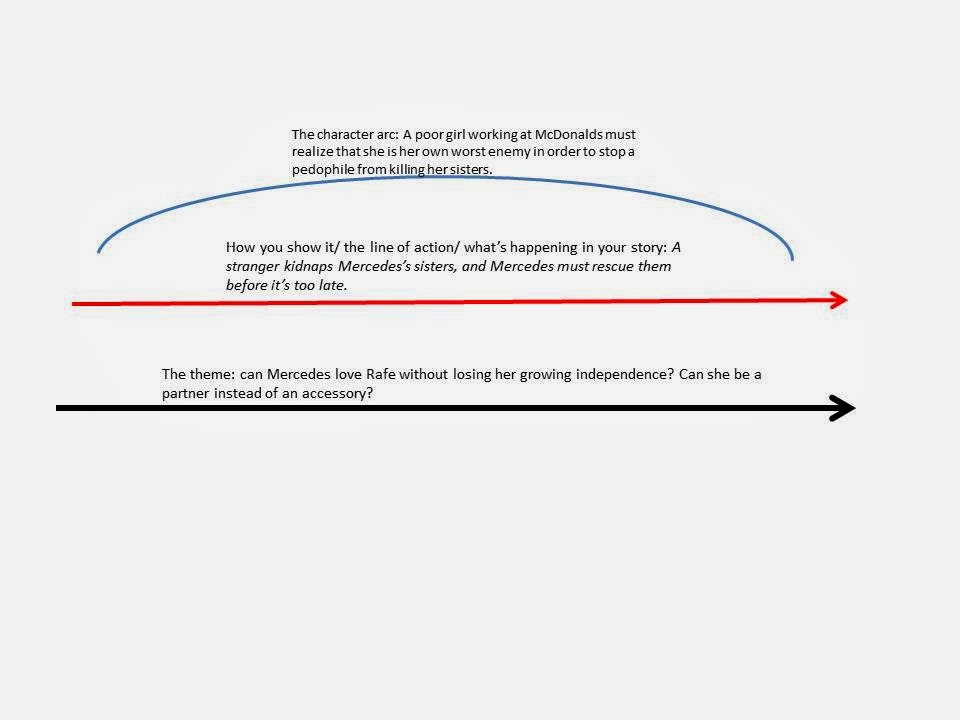
One thing I’ve gotten a lot firmer on over the years is the difference between contemporaries and stories with a heavy dose of external events, like paranormals, romantic suspense, mysteries and thrillers. I usually use Kim’s story to talk about emotional structure and Mercedes to talk about the transformational arc, because they’re vastly different stories. Kim’s story, being a contemporary, has no big external story arc. Kim needs to open her bed and breakfast on time, but if push comes to shove, she can do it without a bathroom in the bridal suite. Mercedes’s story, being a romantic suspense, has a huge, fast-running external arc. She “needs” to find her sisters before the villain kills them which means the space between pt A (the way she starts out) and pt B (her transformational point) is full of scenes that address three things. The externals (rescuing her sisters), her arc (she needs to stop holding herself down or she’ll never change in time to rescue the twins) and her relationship with the hero (since this is a romance). These three things flip-flop around, depending on what you’re writing. If you’re writing a mystery, the scenes need to address solving the mystery and the protagonist’s arc, but not necessarily a relationship of some sort. “However” if it’s a contemporary, the scenes should address Kim’s transformational arc and her relationship with Jason, although not necessarily Kim’s battle to fix up the bed and breakfast.

The arc is the blue line on top, the line of action (or how you're showing the arc) is the red line and the black line is theme. All stories have theme, even if the writer is using it subconsciously. It works to keep everything on the straight and narrow, and helps when it comes to figuring out what scenes need to be in the story. And that...is a post for another day.

Granny Jo

Tuesday, December 31, 2013

The push and pull of conflict in a transformational character arc


Hi! My name is Jodi. You can call me Granny Jo. I always thought I was the strange, kind of backwoods granny without a filter, sort of like Duck Dynasty does Granny Clampett, but I suspect I’m more of the geeky, weird granny who runs around in Crocs and writes on her arm with sharpies.

Recently, I got out of a workshop on advanced alternative GMC where I had the pleasure of talking to Janet again. Janet has a mind like a steel trap and calls me out anytime I weasel word something. Lucky for me, she had a question about Hague. I’m not sure if it means this particular section of the workshop needed to be reworked or if it was just a question and I’m over-thinking it. I’d asked if she could see the events between pt. A (the way a character starts out at the beginning of the transformational point) and pt. B (how they change)?

I can see some of them (the really big ones) but I'm not sure how much change the character needs to show in the first half of the story between the inciting incident and midpoint

Michael Haigh in his Identity to Essence lectures says the character shows a significant change at the midpoint stepping into his/her "essence" before one last reversion to identity, but it's the part up to the midpoint that I'm not sure how to plan.  He mentions the character glimpsing his/her essence early on before the midpoint but he didn't say any more than this.

True, he doesn’t say much more, but I’ve always had the feeling he kind of assumed there was going to be a push and pull of conflict as the character races toward the transformational point.

Kim’s arc is to let go of pain and open up to love again, a statement which really doesn’t spell out what needs to be in the story or how much of it there needs to be. However, you might say Kim’s essence (who she really is on the inside) is an open, loving woman with no pain, and she first glimpses that when she goes over for the first dinner. 

“Oh...” she thinks to herself, “this is what it would be like if life was different, if I could let go of my pain and accept love back into my life. It’s so warm and…I really want it.”

But she can’t, because she’s got a lot of trauma and guilt (her subconscious conflict) Her conscious conflict (she just doesn’t have time for a man in her life, especially not with the B&B getting ready to launch and staying true to her husband’s dream) tells her to push Jason away (in the process she’s also pushing away Tyra, a total win-win). Consciously, she’s just trying to stay on track, while subconsciously she’s afraid of pain, and suffering from “I can’t love this child, that’s a betrayal of Cleo’s memory. I killed Cleo. I let her down. I can’t let her down again.”

However, her essence (the open, loving woman without pain) is pulling at her, forcing her along the path that leads to Jason and Tyra. It’s her subconscious goal.

However, there’s a condition to the way Kim’s conflict works to show change in her arc. Her change needs to happen in feasible increments. She can take one step back and one step forward, or three steps forward and a gigantic step back, but the progression of her change has to work for the story and projected word count. Kim simply can’t go from “I’m hurting and messed up,” to “Aww…I luv you.” She has too much baggage.

The events you pick as the starting and change points of your character predetermine how much change needs to happen between the start of the arc and the final wrenching struggle where the character fights change (the black moment). Kim can’t be healed in a short story because people don’t easily toss years of painful baggage aside. She needs space to show the progression of her arc, which means the amount of change to show before the black moment depends on two things; the events you pick as the starting point and point of change, and word count.

Because I picked such a difficult arc, more change needs to happen in a way that’s believable for a reader. However, if I were to pick a shorter arc (maybe from the death of her husband due to natural causes until her realization love can happen twice) there’s less to show.

In this part of the story how aware will the character be that s/he is changing?  Will s/he realise at all (and maybe rationalise it away with an external reason for acting in a different way) or will it just be the reader who can see it and maybe the catalyst character?

The reader is usually aware of what’s going on because they can see into the character, feel her thoughts and hear her self-talk. In many stories, the point of change happens when the character becomes self-aware and starting acting on their subconscious goal. Kim has been trying to change ever since that first dinner with Jason and his kid, but until she realizes pain and self-hatred are standing in her way, she can’t release them and step into her essence.

If she realizes she’s changing, it probably happens in flashes of “I really want this” only to be rationalized away by “I must be tired and maudlin” or “I just don’t have time for this.”

I think the hero sees it on a certain level, although subconsciously. It’s the intangible that gives him the faith to keep going, even when Kim is fighting herself. So yes—in flashes for him too, complicated by his own internal conflict.